Summary
Building an enterprise-grade ecommerce price monitoring system requires a robust scraping pipeline, strict rate governance, and a resilient multi-tier proxy infrastructure. Major retailers like Amazon and Walmart deploy aggressive anti-bot defenses that instantly flag datacenter IPs. By leveraging high-trust rotating residential proxies, static ISP proxies, and rotating mobile proxies from providers like NiuProxy, engineering teams can bypass CAPTCHAs, achieve 99.9% data accuracy, and scale tracking operations globally while utilizing promo code PAY2 for a 10% discount.
Introduction: Why Modern Retailers Need an Automated Price Monitoring System
In today’s fast-paced digital marketplace, static pricing models are obsolete. Competitors adjust prices dynamically multiple times a day based on inventory levels, competitor tracking, regional demand, and algorithmic repricing tools. For digital marketers, e-commerce brands, and data analysts, manual price checking is no longer feasible.
To stay competitive, you must know How to Build an Ecommerce Price Monitoring System with Proxies that operates autonomously 24/7. However, scraping top-tier retail sites without proper infrastructure leads to immediate IP blacklisting, HTTP 403 Forbidden errors, and endless CAPTCHA loops.
This comprehensive guide walks you through architecting, coding, and scaling your own real-time price monitoring system using production-grade proxy solutions from NiuProxy, ensuring your data pipeline remains stable, cost-effective, and undetectable.
For related insights on optimizing your data pipeline, check out our guide on E-commerce Price Scraping with Proxies and our deep dive into Proxy Rotation Best Practices.
1. System Architecture Overview
An enterprise-ready ecommerce price monitoring system cannot rely on simple, linear scripts. It requires a decoupled, resilient architecture capable of handling rate limits, session management, and data parsing efficiently.
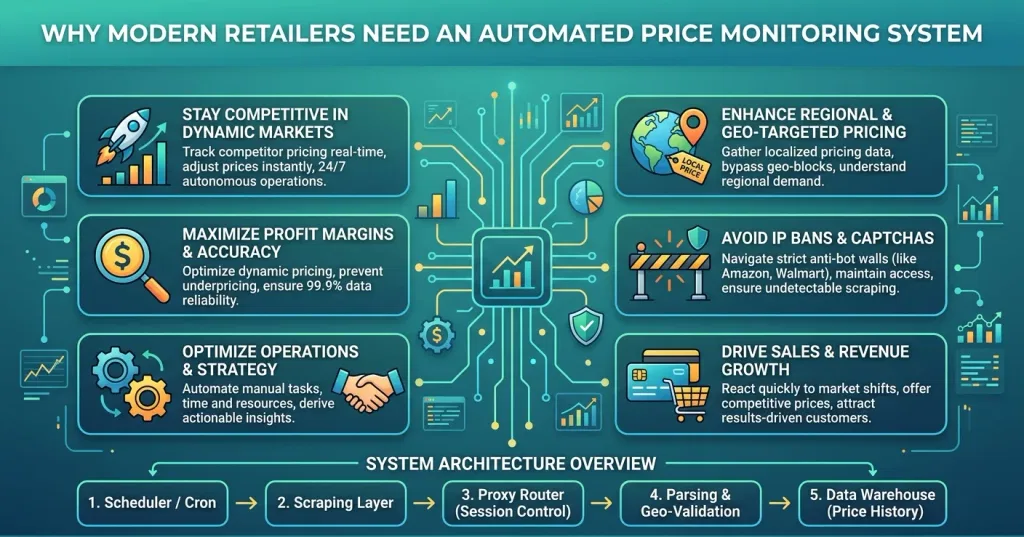
The enterprise price monitoring infrastructure consists of five interconnected layers that form a continuous data flow:
Scheduler / Cron
Role: Triggers automated scraping jobs based on defined schedules or specific intervals.
Flow: Sends initiation signals to the Scraping Layer.
Scraping Layer
Role: Executes data extraction requests targeted at specified e-commerce websites.
Flow: Sends outbound request traffic to the Proxy Router (Session Control).
Proxy Router (Session Control)
Role: Manages IP rotation, sticky sessions, and geographic routing to bypass anti-bot mechanisms.
Flow: Forwards the Rotated Request directly to the target website/endpoint, then routes the retrieved raw response to the Parsing & Geo-Validation layer.
Parsing & Geo-Validation
Role: Receives raw page responses, extracts relevant price/product metrics, validates geographic pricing context, and cleans the data.
Flow: Sends structured, validated data records to the Data Warehouse.
Data Warehouse (Price History)
Role: Stores structured historical pricing data for trend analysis, dynamic repricing, and automated alerting.
The Five Core Layers of Your Architecture
- Scheduler & Cron Layer: Triggers collection jobs based on competitor update frequencies (e.g., hourly scans for fast-moving electronics, daily checks for apparel).
- Scraping Layer: Executes lightweight HTTP requests or headless browser instances to fetch raw HTML/JSON data.
- Proxy Router (Session Control): Dynamically routes outbound requests through clean IP pools, managing rotation intervals and sticky sessions.
- Parsing & Geo-Validation Layer: Extracts clean price metrics, validates regional currency, and confirms that the local store layout matches the targeted geographic market.
- Data Warehouse & Alerting Layer: Stores historical price trends in a database and triggers instant alerts when competitor price drops cross predefined thresholds.
2. Selecting the Right Proxies for Ecommerce Monitoring
Different retail targets require different proxy behaviors. Matching your proxy type to the target’s security profile keeps operational costs low and success rates high.
| Proxy Type | When to Use | Why It Works | NiuProxy Advantage |
|---|---|---|---|
| Datacenter Proxies | Simple catalog pages, smaller stores, low-friction targets. | Fast and highly cost-effective, though easily flagged by strict anti-bot walls. | High-speed infrastructure with global coverage. |
| Rotating Residential Proxies | Aggressive anti-bot platforms (Amazon, Walmart), geo-targeted pricing checks. | IPs originate from real household ISPs; easily bypasses trust-scoring metrics. | 80M+ IP pool (Promax) starting at $0.38/GB with city-level targeting. |
| Static ISP Proxies | Long-term sessions, account management, secure price verification. | Combines datacenter speed with residential IP credibility. | Broadcast & Premium Native IPs (7-day and 30-day plans). |
| Rotating Mobile Proxies | Extremely sensitive sites with dynamic pricing and strict mobile security. | Assigned by cellular carriers; almost never subnet-blocked due to massive IP sharing. | High anonymity pools starting from $1.50/GB. |
Rotating vs. Sticky Sessions: Which Should You Use?
- Rotating Sessions: Assigns a fresh IP for every independent request. This is ideal for scanning broad catalog pages, search results pages (SERPs), or independent product listings.
- Sticky Sessions: Holds the same IP address for 5 to 10 minutes. Use this when your scraping target requires a multi-step workflow, such as selecting a delivery region, adding an item to a cart, or calculating localized zip-code promotions.
3. Step-by-Step Python Implementation
Below is a complete, production-ready Python script that implements the core logic for your ecommerce price monitoring tool. This script utilizes requests to fetch data, BeautifulSoup to parse HTML, and routes traffic through a high-performance proxy gateway.
Step 1: Install Dependencies
Bash
pip install requests beautifulsoup4
Step 2: The Core Scraping & Proxy Script
Python
import requests
from bs4 import BeautifulSoup
from datetime import datetime
# 1. Define target product and your NiuProxy gateway credentials
TARGET_URL = "https://books-to-scrape.com"
# Configure with your NiuProxy endpoint details
PROXY_HOST = "gateway.niuproxy.com"
PROXY_PORT = "8000"
PROXY_USER = "your_username"
PROXY_PASS = "your_password"
# 2. Format the proxy dictionary (supporting HTTP and HTTPS authentication)
proxies = {
"http": f"http://{PROXY_USER}:{PROXY_PASS}@{PROXY_HOST}:{PROXY_PORT}",
"https": f"http://{PROXY_USER}:{PROXY_PASS}@{PROXY_HOST}:{PROXY_PORT}"
}
# 3. Configure realistic request headers to blend with organic user traffic
headers = {
"User-Agent": "Mozilla/5.0 (Windows NT 10.0; Win64; x64) AppleWebKit/537.36 (KHTML, like Gecko) Chrome/120.0.0.0 Safari/537.36",
"Accept-Language": "en-US,en;q=0.9"
}
def monitor_price():
try:
# Route the request securely through the proxy layer
response = requests.get(TARGET_URL, proxies=proxies, headers=headers, timeout=10)
# Guard against HTTP failures (e.g., 403 Forbidden, 429 Too Many Requests)
if response.status_code != 200:
print(f"Request failed with status code: {response.status_code}")
return None
# 4. Parse the page data
soup = BeautifulSoup(response.text, 'html.parser')
# Locate the elements (Update selectors based on your target site's layout)
title = soup.find('h1').text.strip()
price_text = soup.find('p', class_='price_color').text.strip()
# Clean price string into a structured decimal value
clean_price = float(price_text.replace('£', '').replace('$', ''))
# 5. Build a comprehensive data record
price_record = {
"timestamp": datetime.utcnow().isoformat(),
"product_title": title,
"price": clean_price,
"currency": "GBP",
"status": "VALIDATED"
}
return price_record
except Exception as e:
print(f"An error occurred during collection: {e}")
return None
if __name__ == "__main__":
data = monitor_price()
print("Collected Observation:", data)
4. Data Validation and Normalization
A price record must contain reliable context; a false alert is often more disruptive to business logic than a missing scrape. Ensure your pipeline parses and stores the following mandatory components:
- Canonical Keys: Track variations over time using steady metrics like SKUs, GTINs, or MPNs instead of product titles alone.
- Decimal Precision: Store prices as exact string decimals or integers (in cents/pence) rather than binary floating points to prevent rounding discrepancies.
- Geo-Validation: Log both the requested proxy location context and the actual visible location returned on the store’s web layout. A proxy exit node in Chicago doesn’t guarantee the website didn’t serve a warehouse menu for New York.
- Context Separators: Keep separate logs for standard public listings, member-only discounts, coupon-applied variables, and out-of-stock items.
5. Keeping Operations Stable and Ethical
- Be Considerate with Rates: Schedule scans around key retail updates without flooding target servers. Focus intensive checks during peak change windows and use daily updates for stable catalogs.
- Isolate Failures: Never mix invalid parser drops with true business data. Store raw responses separately so a structural layout change by a competitor doesn’t trigger a false pricing alert.
- Use Javascript Only When Demanded: Stick to lightweight HTML or JSON endpoints first. Resort to resource-heavy headless browsers (like Playwright or Selenium) only when dealing with dynamic JavaScript promotions or price decryption masks.
For additional best practices on maintaining infrastructure longevity, review our guide on Ensuring High Availability in Web Data Pipelines.
6. Supercharge Your System with NiuProxy Solutions
Deploying a reliable price monitoring tool requires enterprise-grade infrastructure. NiuProxy offers flexible, high-performance proxy solutions tailored specifically for e-commerce intelligence, web scraping, and automated market research:
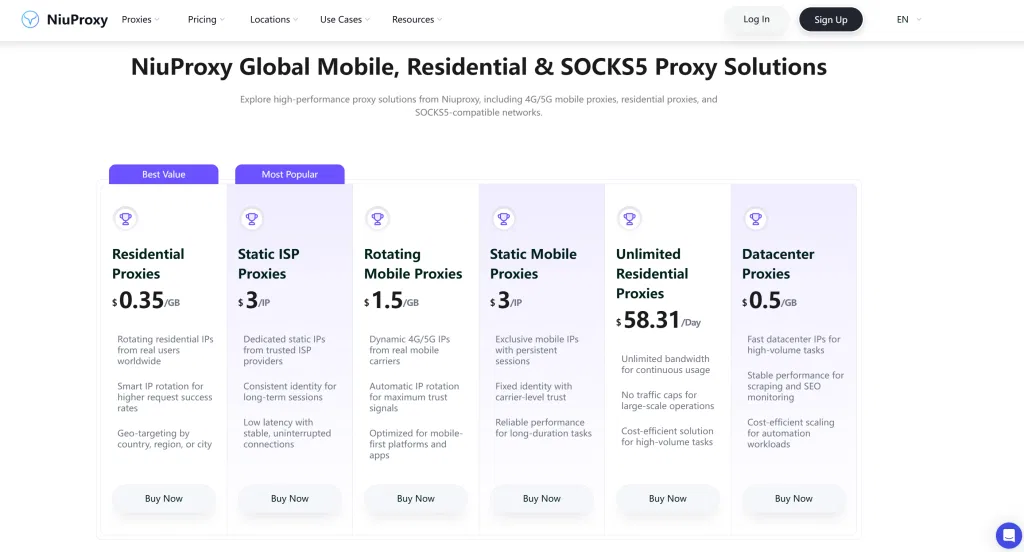
- Rotating Residential Proxy Promax & Pro: Ideal for large-scale catalog scraping with country and city-level targeting across an 80M+ IP pool. Pricing starts as low as $0.35/GB.
- Static ISP Proxies: Perfect for long-term session persistence and account management. Choose between Broadcast ($3-$6) and Premium Native ($5-$9) IPs.
- Rotating Mobile Proxies: High-anonymity cellular IPs designed for ultra-sensitive retail platforms starting at $1.50/GB.
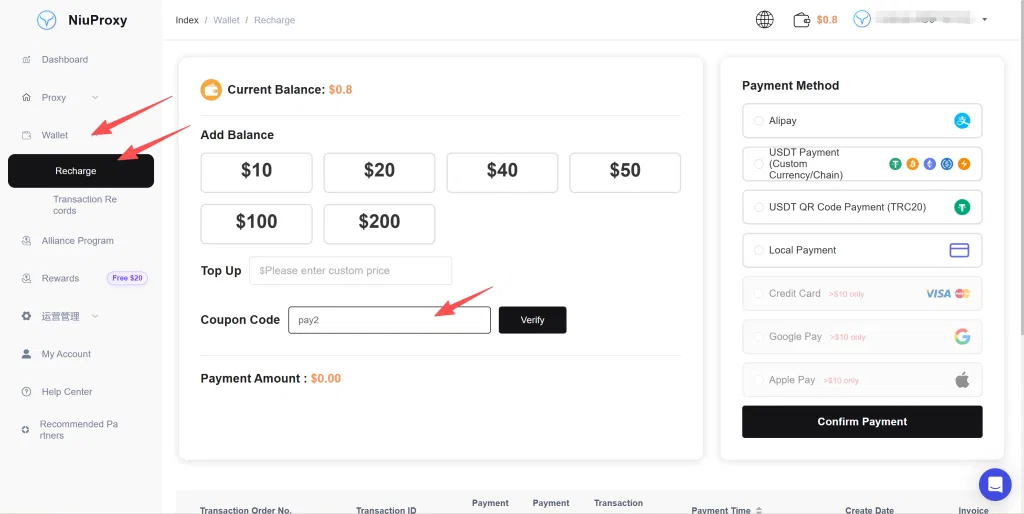
Exclusive Reader Offer: Use promo code PAY2 at checkout to get 10% OFF your next recharge on NiuProxy! Visit NiuProxy Official Website to get started.
7. Frequently Asked Questions (FAQ)
Why do I need residential proxies instead of datacenter proxies for price monitoring?
Major e-commerce platforms like Amazon and Walmart deploy advanced web application firewalls (WAFs) that instantly detect and block data center IP ranges. Residential proxies route your scraper through real household ISP connections, making your traffic indistinguishable from genuine organic shoppers.
How do I handle currency conversion and regional pricing differences?
By utilizing NiuProxy’s city and country-level targeting features, you can route your scraping requests through specific geographic nodes. This ensures your parser retrieves the exact localized pricing and currency displayed to buyers in target markets.
How can I save on proxy costs when scaling my monitoring system?
You can optimize costs by leveraging volume-tier discounts (such as NiuProxy’s bulk pricing down to $0.35/GB) and applying promo code PAY2 for an instant 10% discount on recharges.
Conclusion
Building an automated ecommerce price monitoring system is essential for maintaining a competitive edge in today’s dynamic retail landscape. By combining a well-structured scraping architecture, strict data validation, and premium proxy infrastructure from NiuProxy, your business can collect accurate, real-time pricing intelligence without encountering blocks or CAPTCHAs. Ready to scale your operations? Head over to NiuProxy today and remember to apply code PAY2 to save 10% on your deployment!