Summary
Verifying the Autonomous System Number (ASN) is essential for validating a residential proxy. By inspecting exit IP routing data, digital marketers and data analysts can separate genuine home ISP connections from disguised datacenter servers, ensuring zero-block operations for web scraping, ad verification, and SEO tracking. Use code PAY2 for 10% off at NiuProxy.
Introduction: Why Standard IP Checks Fail Modern Automation
If you manage large-scale web data extraction, multi-account management, or global SEO rank tracking, you have likely encountered sudden blocks, endless CAPTCHAs, and restrictive ban waves. You purchase what is advertised as a “premium residential proxy pool,” yet target web applications flag your requests within minutes. Why does this happen?
The digital proxy market is frequently compromised by spoofed inventory. Low-tier vendors often blend cheap cloud hosting servers into their pools, passing off datacenter IPs as genuine home connections. To protect your operations, surface-level IP lookups are no longer sufficient.
Learning How to Check the ASN of a Residential Proxy is a critical skill for digital marketers, SEO professionals, and enterprise data engineers.
In this comprehensive, practitioner-led guide, we will break down what an Autonomous System Number is, walk through a step-by-step detection methodology, examine industry nuances, and show how transparent providers like NiuProxy maintain clean, uncompromised ASN pools starting from $0.35/GB with promo code PAY2.
For deeper context on structuring your workflows, explore our related guides on Why Are Residential Proxies Detected as Datacenter IPs and Residential vs Datacenter Proxies.
What is an ASN Proxy and Why Does It Matter?
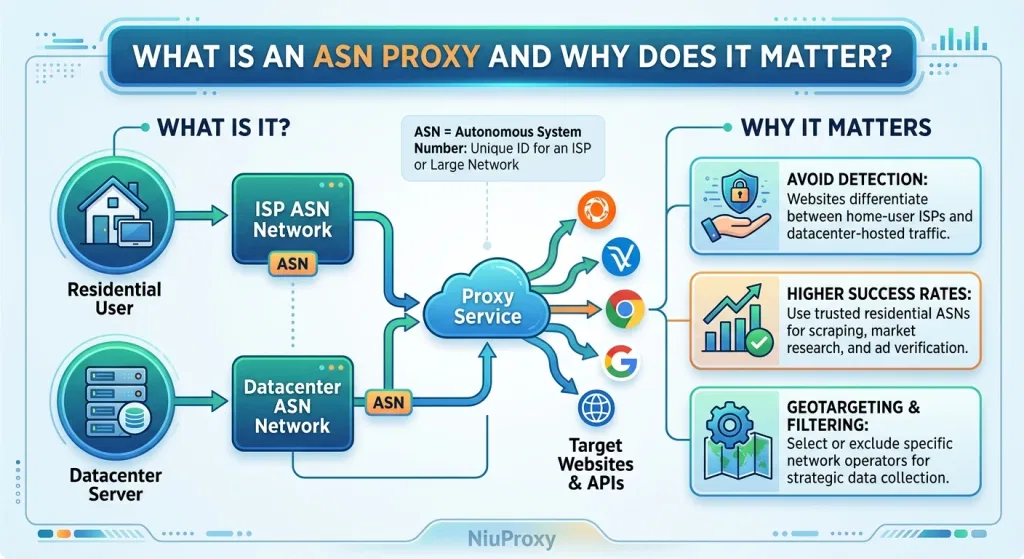
Before diving into the technical auditing mechanics, let’s define the terminology. People often discuss an asn proxy or proxy asn, but what do these terms mean for day-to-day data collection?
An Autonomous System (AS) is a large network or collection of IP routing prefixes managed by a single administrative entity—such as a major consumer Internet Service Provider (ISP) like Comcast, Vodafone, or Deutsche Telekom, or a cloud enterprise like Amazon AWS. Each AS is assigned a globally unique identifier known as an Autonomous System Number (ASN).
When data analysts ask, “What is ASN of proxy?”, they are looking for the specific network routing identifier linked to the exit node handling their traffic.
Key Concept Breakdown:
- ASN Aligned Proxy: A proxy configuration where the exit IP belongs strictly to a designated consumer broadband or mobile carrier ASN, ensuring maximum trust scores.
- ASN Targeting Proxies: An advanced feature allowing enterprise teams to target specific regional ISPs or cellular carriers (e.g., routing traffic exclusively through localized telecommunication ASNs for precise ad verification).
For instance, a genuine residential connection in North America might route through ASN 7922 Comcast Cable Communications Residential ISP, whereas a deceptive proxy might route through a cloud hosting provider’s data center. Understanding these routing footprints gives you complete control over your digital visibility.
The Hidden Threat: Datacenter vs. Residential ASNs
Advanced Web Application Firewalls (WAFs) like Cloudflare, Akamai, and PerimeterX do not just review your IP address; they query global BGP routing tables to verify the owner of the ASN.
If a request originates from an IP address tied to a known cloud hosting provider, the WAF flags it immediately. Many inferior vendors fail to filter out datacenter ASNs, exposing your automated tasks to instant bans.
Comparison Table: Residential vs. Datacenter ASN Characteristics
| Feature | Genuine Residential Proxy | Spoofed Datacenter / Hosted IP |
|---|---|---|
| ASN Owner Type | Consumer ISP (e.g., Comcast, AT&T, Vodafone) | Cloud / Hosting Provider (e.g., AWS, DigitalOcean) |
| BGP Routing | Residential broadband allocation block | Data center / Virtual Private Server (VPS) block |
| IP Reputation | High trust, low fraud score, natural rotation | Frequently flagged, high abuse history |
| WAF Detection Risk | Low (treats traffic as organic human users) | High (instantly blocked or challenged with CAPTCHAs) |
| Ideal Use Case | Web scraping, social media automation, ad verification | Heavy bulk file downloading where anonymity matters less |
As you scale your infrastructure, maintaining strict standards for IP cleanliness is vital.
Step-by-Step Guide: How to Check the ASN of a Residential Proxy
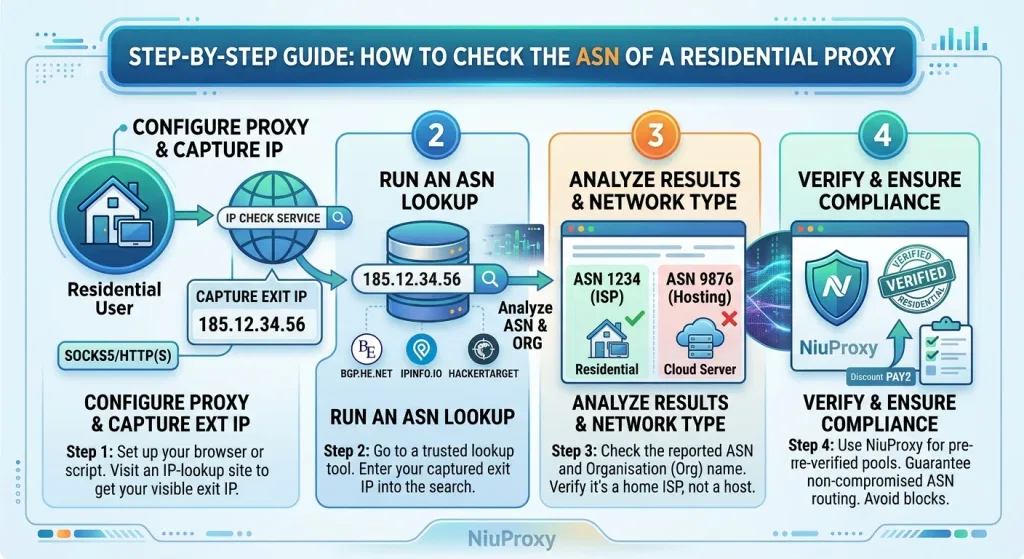
Checking the Autonomous System Number (ASN) of a residential proxy involves capturing its current exit IP address and running it through an IP routing or lookup service. Follow this tested, 9-step methodology used by security analysts and enterprise scraping engineers.
Step 1: Capture the Exit IP Address
- Configure your browser, script, or scraping tool to route traffic exclusively through the residential proxy you want to test.
- Open an IP-check or “What is my IP” service (such as ipinfo.io, bgp.he.net, or a general lookup page) through that active connection.
- Record the exact exit IP address that the external site sees—not your local network’s actual IP.
Pro Tip: If you are testing raw socket connections like a socks proxy what is asn password setup, ensure your authentication credentials and proxy ports are correctly bound before executing your request script.
Step 2: Run an ASN or BGP Lookup
- Go to an IP/ASN lookup utility like BGP Hurricane Electric (bgp.he.net) or IPinfo (ipinfo.io).
- Alternatively, you can use specialized developer tools or command-line utilities that interface with ipinfo privacy detection vpn proxy hosting asn documentation.
- Enter the captured exit IP address (e.g., a test node string like 13.228.203.217 ip reputation abuse vpn proxy asn geolocation) into the search bar.
Step 3: Analyze the ASN and Organization Name
- Review the returned results for the ASN (e.g., AS7922) and the Organization (Org) name.
- Real Residential Indicators: A genuine residential proxy should resolve to a consumer broadband, mobile carrier, or traditional home/office ISP (e.g., Comcast, Vodafone, Rostelecom, or MTS).
- Datacenter/Hosting Warning: If the organization name includes terms like Hosting, Cloud, Data Center, VPS, Server, or Colo, the proxy is actually a datacenter or spoofed IP range rather than a true residential connection.
Advanced Benchmarking & Technical Nuances
When evaluating proxy providers in the field, enterprise engineers often test specialized edge cases. For instance, researchers frequently analyze benchmarks such as how clean is oxylabs asn proxy provider or examine regional anomalies like a polish asn proxy to see how well local mobile and home carrier pools hold up under heavy automation load.
Furthermore, when dealing with legacy systems or specialized protocols—such as configuring a socks proxys asn or managing a socks proxys asn password authentication string—syntax errors can sometimes cause unexpected fallback routing through default server gateways. Always verify that your proxy manager does not silently leak your server’s true datacenter ASN due to a misconfigured routing table.
To explore how mobile networks compare in routing integrity, check out our detailed analysis: Mobile Proxies vs. Residential Proxies: Ultimate Guide.
Enterprise-Grade Solutions: How NiuProxy Solves ASN Verification Challenges
At NiuProxy, we understand that digital marketers and data engineers cannot afford polluted ASN pools or unexpected downtime. When building large-scale automation pipelines, dealing with unverified IP providers leads to wasted budgets and endless debugging.
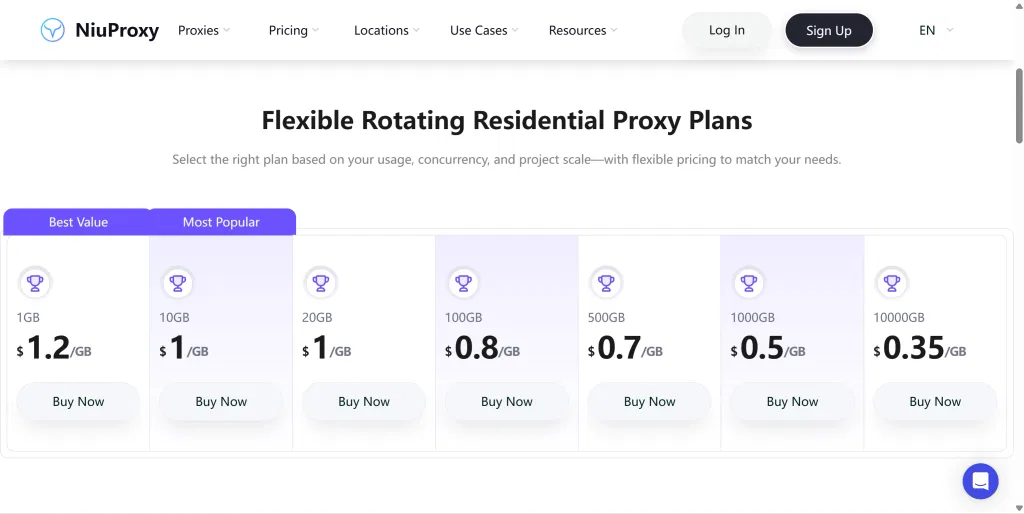
That is why NiuProxy has engineered a robust, transparent infrastructure designed to meet rigorous enterprise standards. Whether you are running localized market research or massive data extraction pipelines, our diverse product lineup ensures clean ASN alignment:
- Rotating Residential Proxies: Sourced entirely from authentic consumer ISPs, giving you millions of legitimate residential IPs with zero datacenter contamination. Plans include Rotating Residential Proxy Promax (ideal for large-scale usage with 1-month validity, starting from $0.38/GB), Rotating Residential Proxy Pro (unlimited validity with approx. 0.14s latency, starting from $0.35/GB), and Rotating Residential Proxy Mini (flexible traffic levels, starting from $0.35/GB).
- Static ISP Proxies (Static Residential): Choose between Broadcast ($3 to $6) and Premium Native IPs ($5 to $9) across 7-day and 30-day plans. Suitable for long-term sessions, account management, advertising, and e-commerce.
- Rotating Mobile Proxies: Utilizing authentic 3G/4G/5G cellular carrier ASNs (13.228.203.217 ip reputation abuse proxy vpn asn geolocation tested clean), starting from $1.50/GB to $4.00/GB, offering the highest level of trust for social media automation and mobile app testing.
- Static Mobile Proxies: Dedicated cellular IP sessions for long-term mobile-based workflows requiring consistent device fingerprints and stable carrier ASNs.
- Rotating Datacenter Proxies: High-speed, cost-effective proxy pools optimized for high-volume non-sensitive data harvesting where speed is paramount.
- Unlimited Residential Proxies: Available for durations from 1 day ($208.50/day) to 30 days ($58.50/day), supporting up to 50,000 QPS and 1,000 Mbps bandwidth.
Real-World Client Success Story
A major e-commerce intelligence firm came to NiuProxy after suffering a 45% block rate using a budget proxy provider whose pools were secretly tainted with hosting provider ASNs. By migrating their infrastructure to NiuProxy’s rotating residential proxies and implementing automated ASN pre-screening (verifying every exit node against consumer ISP databases), they eliminated CAPTCHA blocks entirely, scaling their daily data extraction volume by 300% within two weeks.
Don’t forget to use promo code PAY2 to get 10% off your recharge! For advanced enterprise strategies, review our specialized guide on ASN Got You Blocked? NiuProxy Makes You Look Like a Real User.
Summary Checklist & Actionable Takeaways
To ensure your proxy verification workflow is foolproof, keep this quick checklist handy during your next proxy audit:
- Capture Exit IP: Always test the actual exit IP through your target script, never relying solely on the provider’s dashboard representation.
- Inspect ASN Owner: Run the IP through BGP tools to verify that the organization name matches a consumer ISP rather than a cloud hosting provider.
- Check Fraud & Abuse Scores: Ensure the IP’s reputation history (ipinfo privacy detection vpn proxy hosting asn documentation) is clean before deploying it to high-value accounts.
- Utilize Trusted Providers: Partner with verified infrastructure providers like NiuProxy that guarantee strict ASN transparency and zero hidden datacenter mixing.
Frequently Asked Questions (FAQ)
Can a residential proxy be detected?
Yes, if a provider improperly mixes datacenter IPs into their residential pool or if the IP exhibits abnormal behavioral patterns (such as unnatural request velocities). However, genuine residential proxies backed by clean ISP ASNs are virtually indistinguishable from organic human users.
How can I check for residential proxy?
You can check for a residential proxy by capturing its exit IP address, running a BGP/ASN lookup on platforms like BGP Hurricane Electric, and inspecting whether the ASN belongs to a home broadband provider or a cloud datacenter.
What is ASN for proxies?
The ASN (Autonomous System Number) for a proxy refers to the unique network number of the organization that owns and routes the exit IP address. It is the primary metric websites use to determine if traffic originates from a home network, mobile carrier, or corporate data center.
How can I check an ASN number?
You can check an ASN number by entering any IP address into public IP intelligence databases like IPinfo, MaxMind, or BGP.he.net, which instantly reveal the network owner, country, and routing path.